
 Dog Care
Why Does My Dog Eat So Fast? Causes, Risks, and How to Slow Them Down
You put the bowl down. You walk away. You come back thirty seconds later and it's empty. Your dog is already looking at you like they've never been fed.
Speed eating in dogs is extremely common, and for most dogs it's more of an inconvenience than a danger. But for some dogs, eating too fast carries a real risk, and it's worth understanding which category your dog falls into.
Why Dogs Eat Fast
Competition instinct. Dogs are descended from animals who ate in groups where food could be taken by a faster or more dominant individual. Eating quickly was a survival advantage. Many domestic dogs still carry this drive even in a single-dog household where there's no competition at all. The instinct doesn't require an actual threat. It just fires.
Early life experience. Dogs who had to compete with littermates for food, or who came from environments where food was scarce or inconsistent, often develop speed eating as a habit that persists long after the situation has changed. Rescue dogs who experienced food insecurity are particularly likely to eat fast.
High food motivation. Some dogs are simply very food-driven. Food is exciting, it tastes good, and they want as much of it as fast as possible. This is a personality trait as much as a behavioral one.
Hunger. A dog who is genuinely hungry when they eat will eat faster. If your dog is being underfed, eating twice a day with very long gaps, or has an increased metabolic need they're not getting met, speed eating can be a response to actual hunger rather than instinct alone.
Palatability. Switching to a food that the dog finds significantly more appealing than what they were eating before often produces a temporary speed increase. They're more excited about what's in the bowl.
The Real Risk: Bloat
For most dogs, eating fast means some gulped air, possible vomiting, and an unpleasant few minutes. For certain dogs, it can be life-threatening.
Gastric dilatation-volvulus, commonly called bloat or GDV, is a condition where the stomach fills with gas and then twists on itself, cutting off blood supply. It can kill a dog within hours if not treated surgically. Eating too fast is one of several risk factors.
Dogs most at risk for GDV:
- · Large and giant breeds with deep, narrow chests: Great Danes, German Shepherds, Standard Poodles, Weimaraners, Setters, Dobermans, Boxers, Basset Hounds
- · Male dogs
- · Dogs over seven years old
- · Dogs with a first-degree relative who has had GDV
- · Dogs who eat one large meal per day
- · Dogs who eat from elevated bowls (the research is mixed on this, but it's worth knowing)
Small and medium dogs can get bloat but it's far less common. If you have a large deep-chested dog who eats fast, this risk is something to take seriously.
Signs of bloat to know: distended, hard abdomen, unproductive retching or trying to vomit without bringing anything up, excessive drooling, restlessness, pale gums, rapid breathing. This is a veterinary emergency. If you see these signs, don't wait.
Beyond Bloat: Other Consequences of Fast Eating
Even without the GDV risk, eating too fast causes problems:
Regurgitation. Food eaten too fast doesn't get properly mixed with saliva and may come back up minutes after eating, often in a tube-like, undigested shape. This is regurgitation, not vomiting, and it's common in speed eaters.
Choking. Particularly with large kibble pieces, rapid eating without proper chewing can cause coughing, gagging, or choking.
Chronic gas and digestive discomfort. Gulping food means gulping air. That air has to go somewhere, producing significant gas and discomfort.
What Actually Slows Eating Down
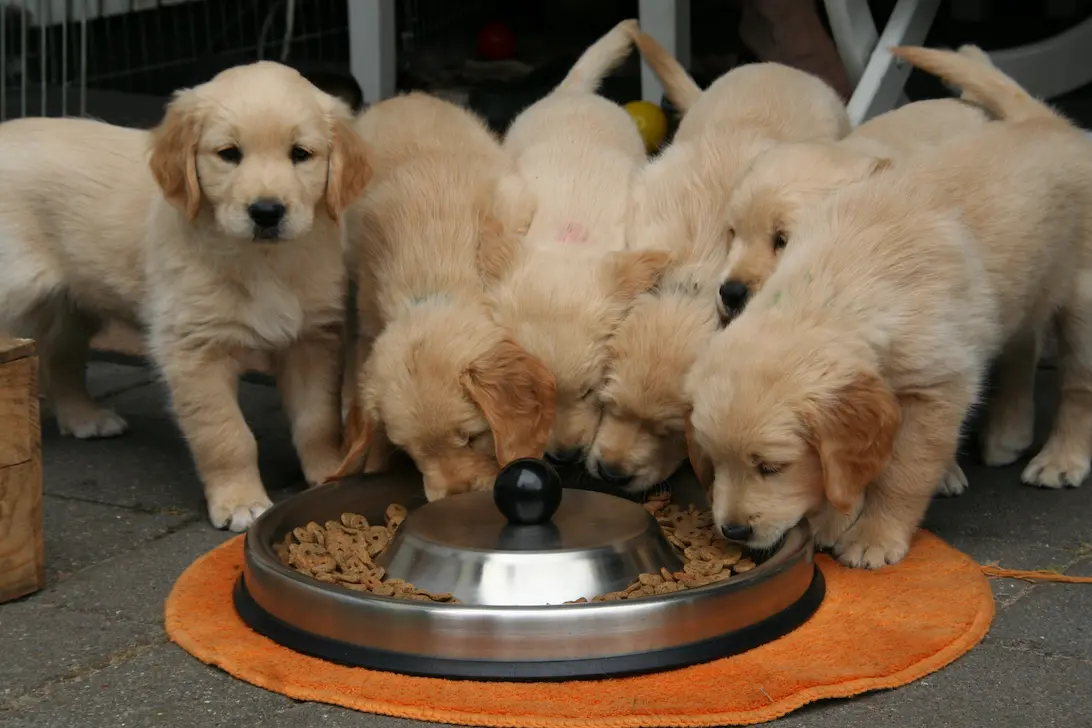
Slow feeder bowls. These have ridges, mazes, or raised patterns that force the dog to eat around obstacles. Most dogs adapt their eating pace significantly within a few meals. They're inexpensive and widely available. This is usually the first thing to try.
Snuffle mats. A mat with fabric loops or ridges that food can be scattered into. The dog has to sniff and search for their kibble rather than eating from a pile. Very effective for speed eaters and adds mild mental stimulation to the process.
Spreading food on a licki mat or baking sheet. Simply spreading kibble flat across a wide surface so the dog can only eat a few pieces at a time. Low-effort, effective.
Puzzle feeders. More complex than snuffle mats, these require the dog to manipulate compartments or levers to access food. Slower eating with more engagement.
Multiple small meals instead of one large one. If your dog currently eats once a day, splitting to twice a day reduces the volume per sitting and the intensity of hunger at each meal. For large breed dogs specifically, multiple smaller meals are generally recommended to reduce bloat risk.
A large ball or food-safe object in the bowl. Placing a large smooth rock, a tennis ball, or a purpose-made bowl insert in the center of the food bowl forces the dog to eat around it. Works reasonably well but less effective than a slow feeder bowl designed for the purpose.
Hand feeding. Time-intensive but effective for retraining. Feeding kibble piece by piece or in small handfuls during a training session slows eating completely and has the side benefit of being a training opportunity.
What Doesn't Help
Scolding or punishing fast eating does nothing. The dog isn't choosing to eat fast in a way that responds to correction. It's instinctive and the punishment happens after the fact anyway.
Simply buying a different bowl shape without specifically choosing a slow feeder design usually doesn't help. Standard bowls, even wide ones, don't create enough of an obstacle.
Tracking Feeding Patterns
If you're switching feeding methods or splitting meals, tracking when and how much your dog eats helps you confirm the new pattern is working and catch any changes. PawTrack lets you log feeding times, amounts, and any digestive symptoms alongside each other, which is particularly useful if you're monitoring a dog at risk for bloat or managing a condition that affects appetite.
The Bottom Line
Fast eating is usually rooted in instinct, learned behavior, or food motivation rather than anything you did wrong. For most small and medium dogs, a slow feeder bowl and a move to twice-daily feeding is enough to reduce the problem to a manageable level.
For large, deep-chested breeds, taking it seriously is genuinely worth the effort. The same slow feeder and split-meal approach applies, but the stakes are higher. A few minutes of slower eating is a small change that significantly reduces a meaningful risk.